


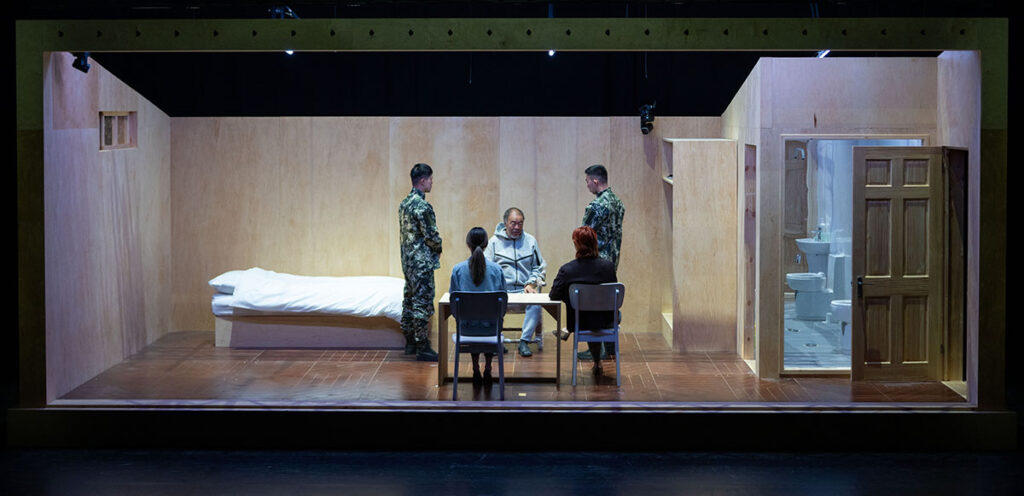
If art is a weapon, then the corollary of such a statement is that it is also a weapon which can be used against the artist. Such was the case with Ai Weiwei who was imprisoned by the Chinese authorities for 81 days 15 years ago.
He recreates the experience with brutal underscoring, inviting us to imagine incarceration and the daily privations which work to grind down the prisoner, particularly one who thinks art can challenge authority. His detention was a scolding reminder of the power of the state and a corrective to the fanciful Western ideal of artistic freedom.
Sewing a Button is both a literal and a figurative recreation of Ai Weiwei’s arbitrary arrest and imprisonment. We see the cramped conditions of his cell, bed hushed up against the wall, one easy chair, a desk a sop to the idea of being able to carry out work, a bathroom where he can only relieve himself watched out over by two doleful guards and where his toothbrush is manacled to the tap.
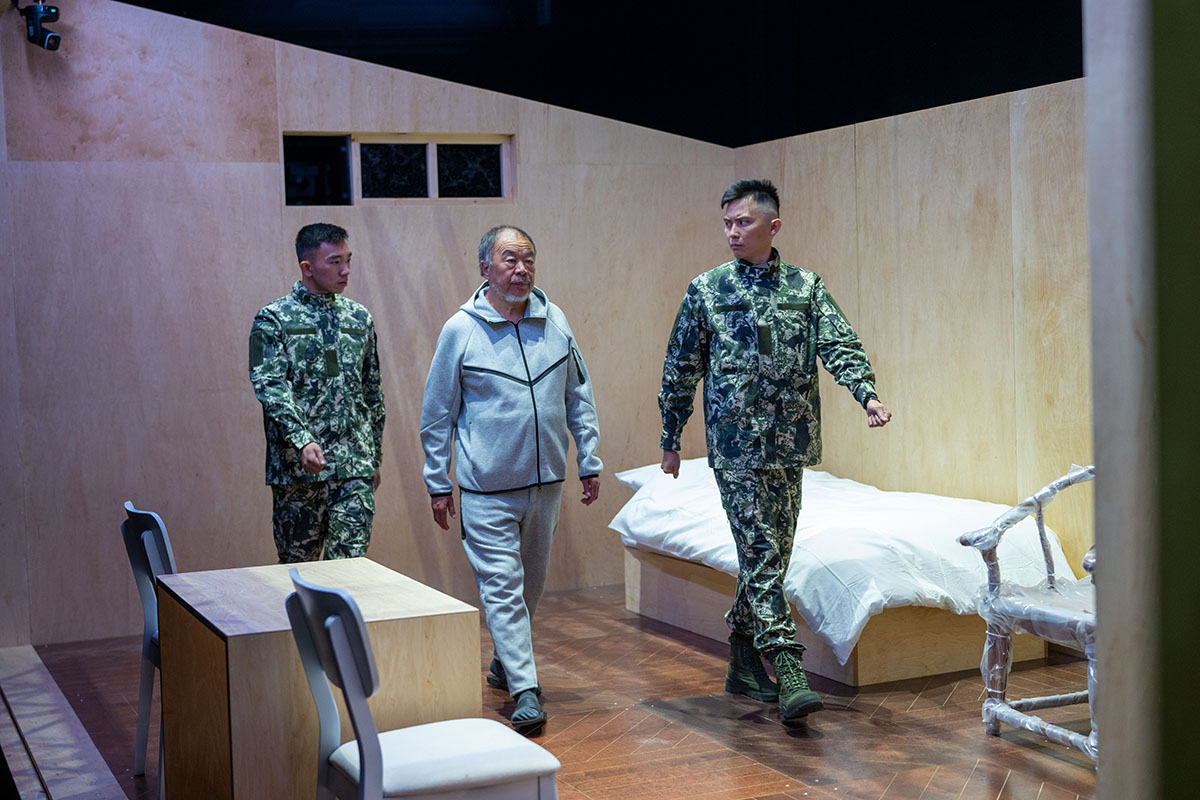
What we mainly see is Weiwei exercising (the mind as well as the body presumably) by traversing his cell floor back and forth, back and forth, flanked by Chinese soldiers, one either side, Weiwei in sliders and joggers, the soldiers in fatigues and army boots. The crushing power of the state lies in its ability to reduce life (and art) to a monotonous exercise where time is stripped of its function as a marker of activity. Occasionally the artist will hold up a hand, a signal that he requires a drink of water. This, though, he cannot get for himself – rather, it is brought to him by a soldier and his every gulp is fastidiously watched over before it is taken off him and he returns to pacing the cell.
Occasionally, glimpses of muffled conversation between Ai Weiwei and his guards can be heard, and he is not spared the ignominy of interrogation. It is in this section that Weiwei is allowed the space to define art, its historical and political function, his words noted down by functionaries of the state. Personal art, he says, can’t change history or push it forward, but it is capable of reflecting changes in society.
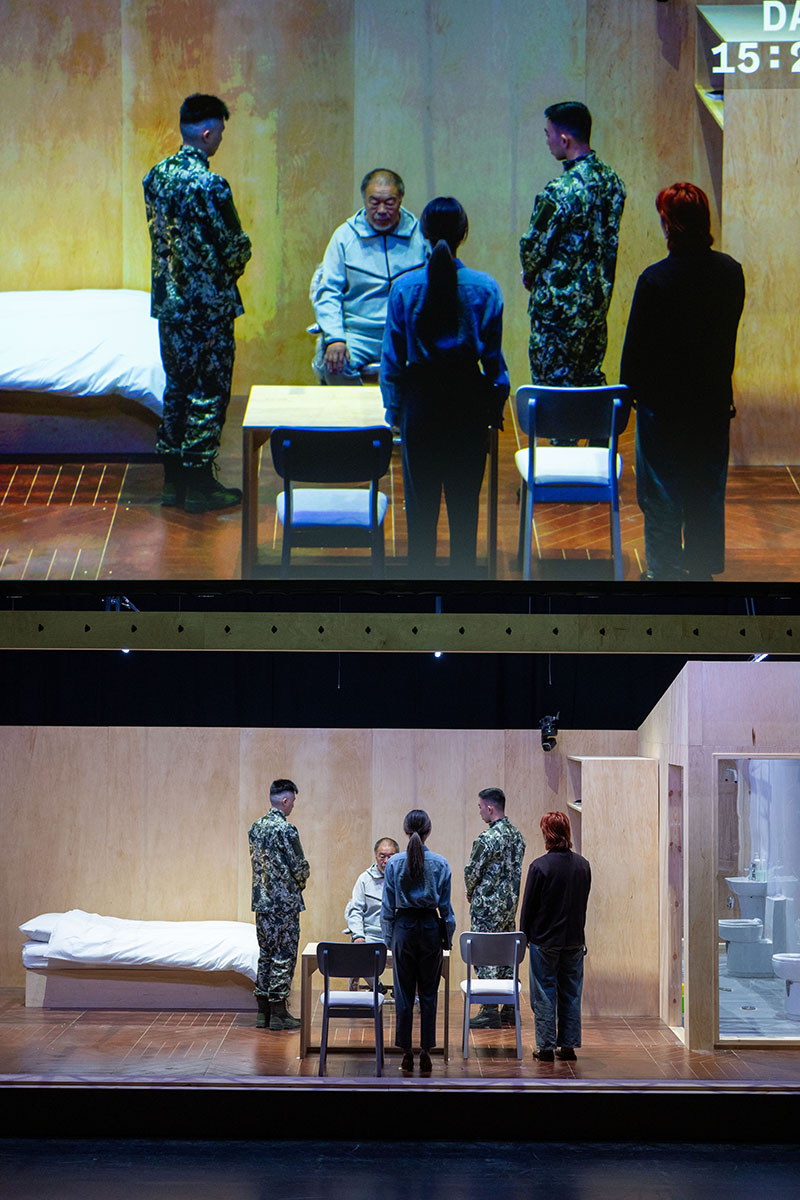
Watching such activity as a ‘spectator’ is simultaneously soporific and chilling, the boredom of the daily exercise and watchful guards a stark contrast to the power of the state machine to exercise control over a person. As we watch Weiwei recreate imprisonment in a 24-hour live performance, projected onto a screen above the stage are different viewpoints of the cell which the audience can imagine themselves in. Surveillance does not end with the guards but is aided and abetted by CCTV cameras.
Lots of artists have been imprisoned for their work, and lots have memorably detailed their experiences, but perhaps none more so in a way which displays the banality of state terror and how ultimately it points to a failure of power rather than its imposition.
Ai Weiwei: Sewing A Button is a 24 hour performance at Aviva Studios on 4 July 2026. You can watch a live broadcast online. This installation is a companion piece to Weiwei’s major new exhibition Button Up! in which the artist explores how historic systems of trade, empire and exploitation resonate in today’s humanitarian and political crises. The exhibition runs until 6 September 2026.