
 Steve Timms
‘There may be trouble ahead.’ In difficult times, people look for an exit. That was the case when the original RKO movie ‘Top Hat’, with Fred Astaire and Ginger Rogers, arrived in 1936 at the height of the Great Depression. Arguably we’re now on the precipice of another great depression.
There’s no simple answer to this, though a quick fix of escapism is a guaranteed, short term antidote. Top Hat is now on stage, in a new adaptation by Matthew White and Howard Jacques. The show’s USP is multi award-winning double threat Kathleen Marshall, a premier league director and choreographer, feted for an acclaimed series of shows on Broadway, and in the West End (her brother is film director Rob Marshall, so it must be in the genes).
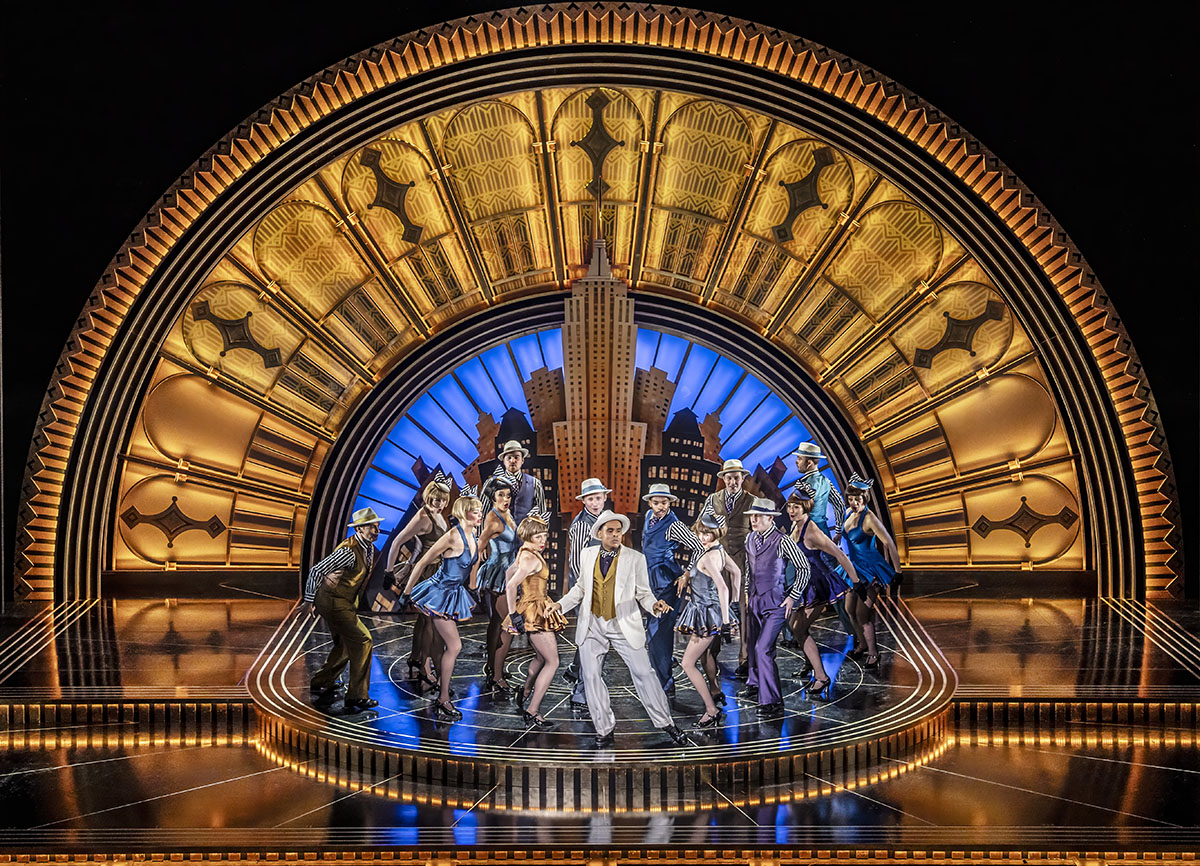
I have to admit to being late to this particular party, only discovering Kathleen Marshall’s talents with the Barbican production of ‘Anything Goes‘ a few years back. The latter was a dazzling piece of popular art, quite unlike anything I’ve ever seen before. Marshall brings the same eye for glamour and sophistication to Top Hat. If it doesn’t surpass ‘Anything Goes’, it is certainly the equal; impressive enough to convert a musical heretic to the joys of song and dance.
In New York, wealthy producer Horace Hardwick (James Hume) hires American entertainer Jerry Travers (Phillip Attmore, possessing Zeus like dancing abilities) to headline a new musical show. The action then zips across the Atlantic to London. Jerry stays in Horace’s hotel suite, and his night time dance episodes (described as ‘tapititus’) are irksome enough to wake pretty Dale Tremont (Nicole-Lily Baisden, a pint size package of fizzy energy) in the room below. When she stomps up to Horace’s suite to tell Jerry to keep it down, he falls instantly in love. The next day, Jerry follows Dale around London, croons and charms until she can resist no longer.
This being the 1930’s, she neglects to ask his name – yes, this is the improbable dramatic device on which Top Hat pivots, because Dale now believes Jerry is Horace (who she’s never actually met). Next stop, Venice. Dale knows Horace is married to sassy redhead friend Madge (Emma Williams), who informs Dale that her husband is staying in the same hotel. Misunderstandings quickly pile on top of each other. To say more would spoil the ride.
Attmore and Baisden make a charming lead couple, though are in danger of being upstaged by the sub plot players, Hume and Williams. Hume is a hilarious bundle of bristling neurosis, seemingly afraid of everything – particularly air travel. “I get frightened when I arrive at the airport, and see the word ‘departures.” Act 2’s secret weapon is Williams who crackles with attitude and whip smart put downs. Hume and Williams have such chemistry, it would be great to see these performers return in a spin off.
I still recall versatile James Clyde from a run of mid 90’s appearances at the Royal Exchange; he deserves a mention for his droll turn as Horace’s jaded valet, Bates. Likewise understudy Zak Edwards, who brings a controlled, toreador energy to the role of flamboyant dress maker, Alberto Beddini.
The mark of a gifted designer is when their work stays in the mind, rather than fading after the curtain. Peter McKintosh’s sumptuous set is a giant art deco clock; at various points, the face spins open to reveal different rooms and suites. Alongside Yvonne Milnes, McKintosh has also created the fabulous costumes. Every member of the company is immaculately attired. Top Hat exists in a rarefied atmosphere of covetous excellence (I’m almost tempted to break into the theatre at night, and steal a souvenir – perhaps Jerry’s duck egg blue suit).
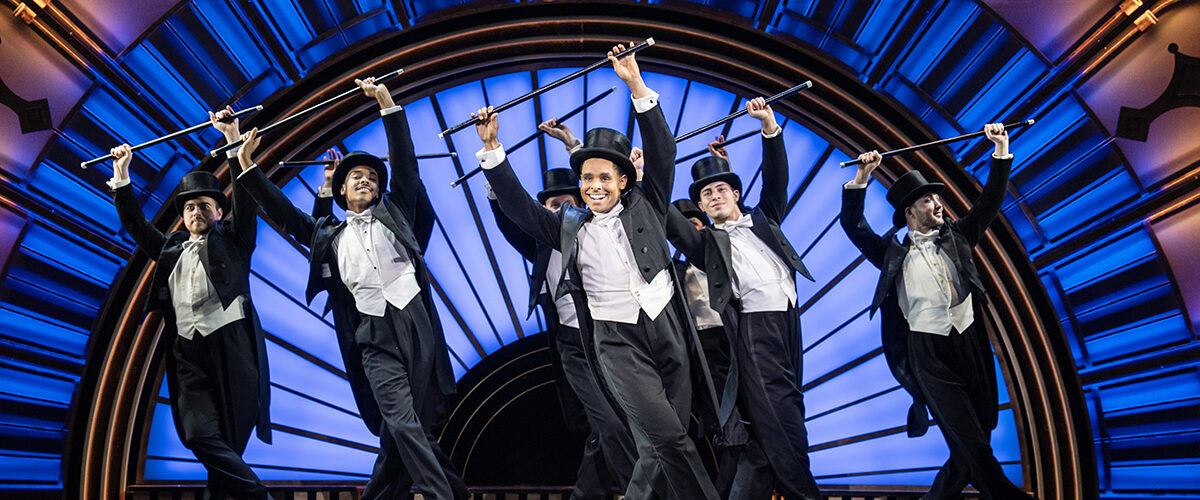
Alongside Cole Porter, Irving Berlin was the prime mover of the great American songbook. His best known tunes might be ‘White Christmas’ and ‘No Business Like Showbusiness’ but those featured in Top Hat are easily the most melodic: ‘Cheek to Cheek’, ‘Putting on the Ritz’, ‘Let’s Face the Music and Dance’ are ear worms that take up permanent residence. The undoubted highpoint of Marshall’s production is ‘Top Hat, White Tie and Tails.’ This is a dance team operating as a hive mind, a series of jaw dropping sequences which include intimate groupings, spiral stage crossing, and dancers tossing and catching canes across parallel lines. How is this sort of thing even possible? A scene like this belongs in a choreographer’s textbook; a blueprint for what the art form can achieve.
Top Hat is as bracing as a glass of chilled champagne in a cryogenic ice bath. But you will have to hurry: this Chichester Festival production is at the end of its tour (Southampton Mayflower follows this Lowry run).

 Dave Porter
 Carmel Thomason
 Anna Ryan
 Amy Corringham